

Trigeminal nerve repair is a highly specialized microsurgical procedure designed to treat injuries to the nerve branches responsible for providing sensation to your face, teeth, lips, and tongue. These complex nerve injuries most commonly occur as a secondary complication from dental procedures, such as lower wisdom tooth extractions, dental implant placement, or orthognathic jaw surgery. At the Maxillo-Facial Surgery Institute Irvine, our surgical team possesses the advanced training and microsurgical expertise required to evaluate, map, and repair these delicate pathways, helping patients regain sensory function and manage chronic neuropathic pain.
Understanding Your Injury: Lingual and Inferior Alveolar Nerves
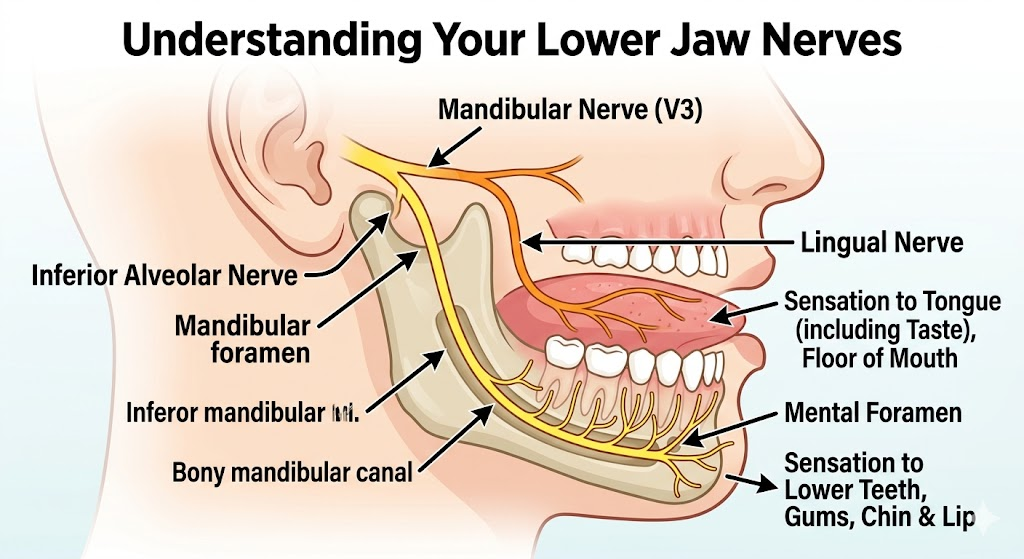
The vast majority of oral nerve injuries involve two specific branches of the trigeminal nerve. Because these nerves run directly through or adjacent to common dental surgical sites, they are the most vulnerable to stretching, bruising, or transaction (severing):
- Lingual Nerve Injury: The lingual nerve travels just inside the jaw bone and provides sensation and taste to the corresponding side of your tongue, as well as the inner gums. An injury here typically causes persistent numbness, altered taste, a burning sensation, or painful hypersensitivity on the side of the tongue. It frequently impacts speaking and eating.
- Inferior Alveolar Nerve (IAN) Injury: The IAN travels directly through a bony canal inside your lower jaw. It provides sensation to your lower teeth, lower lip, and chin. Damage or compression to the IAN results in numbness or altered sensation across the lower lip and chin on the affected side.
Patient Candidacy: Timing and Severity
It is important to understand that not everyone with a nerve injury is a candidate for surgical nerve repair. Qualification depends heavily on two critical factors:
- Severity of the Injury: Mild injuries where the nerve is merely bruised or stretched (neuropraxia) often heal on their own over several weeks or months. Surgery is reserved for severe cases where the nerve is physically torn, severely compressed, or blocked by dense scar tissue (neuroma), showing zero recovery over objective testing intervals.
- The Critical Timing Window: Timing is the single most vital factor in the success of a nerve repair. If surgery is performed too late, the sensory receptors in the brain and the distal nerve pathway degenerate, making recovery impossible. The optimal window for a nerve repair is typically within 3 to 6 months following the initial injury, with a maximum threshold of around 9 to 12 months. Beyond one year, the success rate drops significantly.
Your Nerve Mapping & Evaluation Appointment
Nerve tissue requires meticulous baseline data to monitor. If you are experiencing persistent numbness longer than a few weeks following an oral procedure, we schedule a comprehensive neurosensory evaluation at our Irvine practice:
- Objective Neurosensory Testing: We perform a series of non-invasive, standardized sensory tests to grade your injury. This includes testing for light touch, directional brush strokes, two-point discrimination, and temperature differentiation.
- Virtual Surgical Planning (VSP) & Advanced Imaging: While nerves do not show up on basic X-rays, we utilize high-resolution 3D CBCT scans alongside Virtual Surgical Planning (VSP) when necessary. By mapping your precise skeletal anatomy in 3D, we can pinpoint the exact site of injury—such as an implant protruding into the mandibular canal or a bone plate compressing the nerve path—allowing us to plan your surgical entry with absolute precision.
- Insurance Coordination: Nerve repair surgery requires precise coding and pre-authorization. Our experienced surgical coordinators walk you through the process to streamline your medical insurance coverage.
Microsurgical Treatment & Access Techniques
If your nerve has a severe disruption and falls within the appropriate treatment timeline, we utilize advanced microsurgical techniques under high-power illumination to restore continuity to the nerve path.
Accessing the Nerve via Sagittal Split
When repairing the lingual nerve, access is gained through the soft tissue inside the mouth. However, because the inferior alveolar nerve is completely encased inside the dense bone of the lower jaw, a sagittal split osteotomy is sometimes required. In this procedure, we carefully separate the outer and inner layers of the lower jaw bone along its natural structural planes. This safely opens the mandibular canal, providing our surgeons with direct, unhindered physical access to repair the damaged nerve section without harming the surrounding bone.
Microsurgical Repair Methods
- Nerve Decompression: Meticulous removal of bone fragments, plates, or dental implants that are physically pressing on an intact nerve.
- Direct Neurorrhaphy: If the nerve has been cleanly severed, we trim the frayed edges and use micro sutures (thinner than a human hair) to connect the healthy ends directly without tension.
- Nerve Grafting: If a segment of the nerve is missing or heavily scarred, a direct reconnection isn’t possible. We bridge the gap using a specialized biological nerve allograft scaffold, giving your native nerve fibers a clear path to grow across.
Procedure & Recovery: What to Expect
- Incisions & Aesthetics: The entire surgery is performed inside the mouth. There are no external facial incisions and no visible facial scars.
- Anesthesia: The procedure is completed under general anesthesia in our state-of-the-art facility, ensuring you remain completely comfortable and asleep.
- No Wired Jaws: Your jaws will not be wired shut. Even if a sagittal split osteotomy is performed to access the nerve, the bone is rigidly secured back together using low-profile titanium screws, allowing normal jaw mobility immediately after surgery.
- Slow Regeneration: Nerves regenerate slowly—approximately 1 millimeter per day. Sensory return is a gradual process that can take anywhere from 3 to 12 months. Early healing is often marked by an itchy, tingling, or electric sensation, which is a positive sign that nerve fibers are actively growing.
Consult a Microsurgical Expert in Orange County
If you or a patient is experiencing persistent sensory deficits or neuropathic pain following a dental procedure, early intervention is paramount. Trust our specialized clinical expertise to provide clear diagnostic answers and advanced microsurgical solutions within the critical healing window. Contact the Maxillo-Facial Surgery Institute Irvine in Irvine today to schedule your neurosensory workup.


