

Key Indications: When is Total Joint Replacement Necessary?
Total joint replacement (TJR) is considered the gold standard of care for patients suffering from end-stage, severely degenerated jaw joints. When conservative therapies—such as splints, physical therapy, joint injections, or arthroscopy—have failed to provide lasting relief, TJR can restore function and dramatically reduce chronic pain.
Common indications for an artificial TMJ include:
- Severe Osteoarthritis or Rheumatoid Arthritis: Advanced joint destruction leaving a painful “bone-on-bone” environment.
- Ankylosis: Fibrous or bony fusion of the joint that severely locks the jaw shut.
- Failed Prior TMJ Surgeries: Revision of old implants or failed tissue grafts from previous operations.
- Avascular Necrosis: Loss of blood supply causing the jaw joint head (condyle) to die and collapse.
Idiopathic Condylar Resorption (ICR)
Our clinic provides care for patients suffering from Idiopathic Condylar Resorption (ICR), a progressive condition where the jaw joint head (condyle) inexplicably dissolves over time. Often affecting young women and sometimes referred to colloquially as “Cheerleader’s Syndrome,” ICR causes the lower jaw to recede backward. This leads to distinct structural changes, including a progressively receding chin, the sudden development of a severe anterior open bite (where the front teeth no longer touch), chronic joint noise, and increasing airway obstruction that can cause sleep apnea. At the Maxillo-Facial Surgery Institute, we work to halt this condition, utilizing custom joint replacements to permanently reconstruct the jaw joint, stabilize your bite, and restore normal facial balance and airway health.
Your Comprehensive TMJ Workup Consultation
Designing a custom jaw joint requires immaculate diagnostic data. If you are a candidate for total joint replacement, we gather all essential clinical records during your initial workup appointment at our Irvine office:
- High-Resolution 3D CBCT & Medical CT Scans: We capture sub-millimeter anatomical data of your skull, skull base, and remaining joint structures. This raw data is sent directly to biomedical engineers to manufacture your custom device.
- Digital Intraoral Scans: We create high-definition 3D digital impressions of your teeth to coordinate your post-operative bite perfectly, completely eliminating messy traditional molds.
- Clinical Photography & Range of Motion Tracking: Precise measurements of your maximum incisal opening, lateral jaw movements, and facial proportions are carefully documented.
- Insurance Pre-Authorization Management: Total TMJ replacement requires meticulous medical insurance navigation. Our specialized team coordinates directly with your insurance providers to secure necessary pre-authorizations for your custom-fabricated implants.
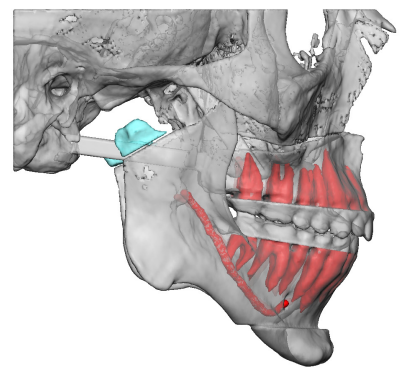
Virtual Surgical Planning (VSP) for TMJ & ICR Patients
We utilize advanced Virtual Surgical Planning (VSP) to completely customize your procedure. Your unique anatomy is used to engineer a patient-specific, custom joint replacement system from TMJ Concepts, a world leader in custom maxillofacial prostheses.
Our dual-degree surgeons work hand-in-hand with clinical engineers to simulate the surgery digitally before you ever enter the operating room:
- The exact boundaries of bone preparation are pre-calculated.
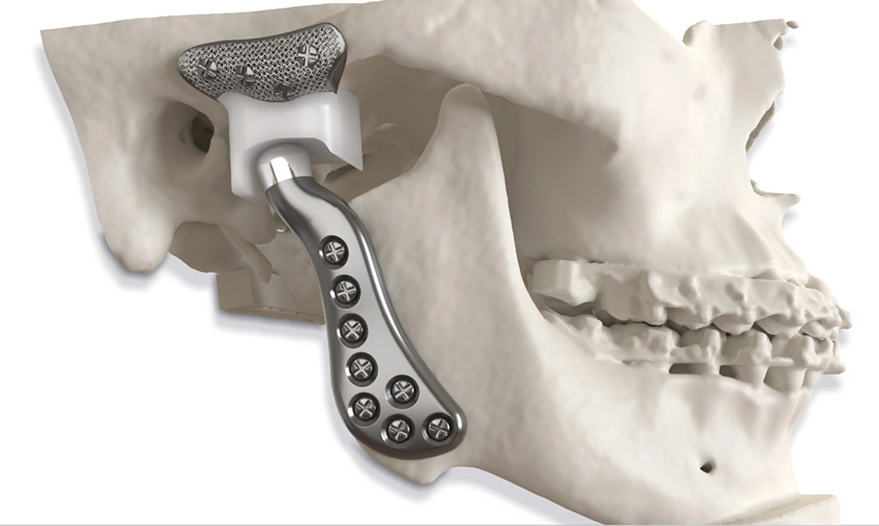
- The fossa (socket) component and condylar (ball/stem) component are custom-built to match your bone shape exactly.
- If your underlying bite needs correction alongside the joint replacement, we perform custom orthognathic jaw movements simultaneously within the software to ensure your teeth line up perfectly.
The Surgical Procedure & Recovery Timeline
Where are the incisions located?
To access the complex anatomy of the TMJ safely, two well-concealed incisions are used on each side:
- Preauricular Incision: Placed hidden within the natural creases immediately in front of the ear to access the joint socket.
- Submandibular Incision: A small incision placed under the jawline in a natural neck crease to access and secure the lower jaw stem component.
Will my jaws be wired shut?
No. We do not wire your jaws shut for TMJ replacements. Rigid internal fixation screws secure your custom titanium hardware completely in place. We utilize light, flexible orthodontic elastics (rubber bands) immediately after surgery to guide your muscles into your new, corrected bite, allowing you to breathe, speak, and clear your airway safely from day one.
Expected Recovery Window
- Hospital Stay: Patients typically remain in the hospital or surgical facility for 1 to 2 nights for pain optimization and physical therapy initiation.
- Early Mobilization: We encourage light jaw movement immediately after surgery to prevent scar tissue formation and ensure the long-term mobility of your new joint.
- Dietary Restrictions: A liquid or soft non-chew diet is required after surgery to improve your healing and recovery
Reclaim Your Quality of Life in Orange County
Living with end-stage TMJ destruction or progressive ICR can be isolating and profoundly painful. Turn to a local authority utilizing the most precise 3D custom engineering available in oral and maxillofacial surgery. Contact the Maxillo-Facial Surgery Institute in Irvine today to schedule your comprehensive Total TMJ evaluation.


