Tooth Extractions
Simple and surgical removal of teeth, with in-office anesthesia options and planning for future tooth replacement where appropriate.
Why a tooth may need to be removed
A tooth may need to be removed when it is badly decayed, fractured, infected or cannot be restored, when it is affected by advanced gum disease, or to make space for orthodontic treatment. Your dentist or orthodontist will often refer you with a recommendation.
Consultation and planning
The visit includes a review of your medical history and medications, an examination and X-rays or 3D imaging to see the roots and nearby structures. If a dental implant is planned later, the extraction can be coordinated with socket preservation.
The procedure
- Simple extraction: a visible tooth is gently loosened and removed.
- Surgical extraction: for teeth broken at the gumline or with curved or fused roots, a small incision is made and the tooth may be removed in sections.
- Socket preservation: a bone graft may be placed in the socket when an implant is planned.
Anesthesia options
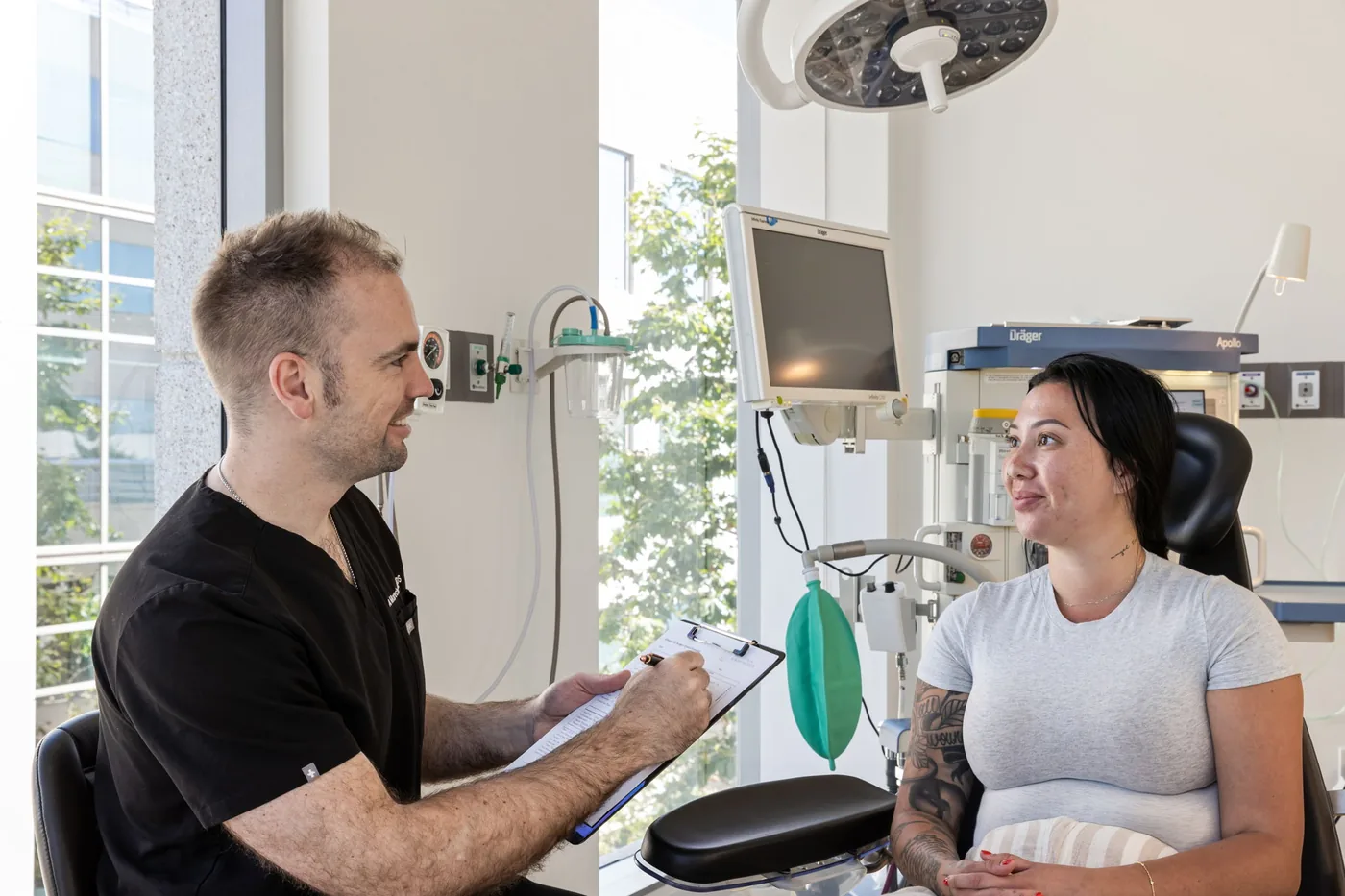
Most extractions are performed under local anesthesia; sedation or general anesthesia is available in our Irvine office. Your surgeon will recommend the option that suits the procedure, your health and your preference. See Anesthesia & Sedation for more detail.
Recovery timeline
Follow the post-operative instructions provided before surgery.
Risks
Possible risks include bleeding, swelling, infection, dry socket (a painful condition when the clot is lost), damage to neighbouring teeth or restorations, sinus involvement for upper back teeth and, uncommonly, numbness of the lip or tongue.
Frequently asked questions
Will it hurt?
The area is numbed before treatment; discomfort afterwards is usually managed with over-the-counter or prescribed medication.
What is a dry socket?
It occurs when the blood clot is lost from the socket early, exposing bone. Avoiding smoking and straws in the first days lowers the risk.
Should I replace the tooth?
Options such as a dental implant, bridge or denture can be discussed with your dentist; socket preservation can help keep bone for an implant.
Your surgeons
Both surgeons provide the full range of oral surgery.

Youn Sagong, DDS
Oral and maxillofacial surgeon. Board-certified by the American Board of Oral and Maxillofacial Surgery. Residency and chief residency, Yale. Assistant Clinical Professor, UCI Medical Center; operating privileges at Hoag Hospital and UCI Medical Center.
Wisdom teeth, extractions, dental implants and bone grafting.
Surgeon profile →
Andrei Marechek, MD, DDS
Oral and maxillofacial surgeon. Board-certified by the American Board of Oral and Maxillofacial Surgery. Residency, Case Western Reserve University. Assistant Clinical Professor, UCI Medical Center; operating privileges at Hoag Hospital and UCI Medical Center.
Wisdom teeth, extractions, dental implants and bone grafting.
Surgeon profile →Performed by surgeons whose practice also includes corrective jaw surgery, TMJ surgery, reconstruction and facial aesthetic surgery.